If you’ve ever asked an LLM to “respond with JSON,” you know the failure mode: it mostly works, then one in fifty replies comes wrapped in a markdown fence, or with a chatty preamble, or with a trailing comma that breaks your parser. When I used a local model to extract structured records from documents, “mostly valid” wasn’t good enough. The fix isn’t a better prompt — it’s a grammar.
Prompts persuade; grammars constrain
A prompt is a request. The model can ignore it. Constrained decoding is different: at each step, the sampler is only allowed to choose tokens that keep the output valid against a formal grammar. Invalid tokens aren’t discouraged — they’re masked out entirely. With llama.cpp this grammar format is GBNF (a BNF-style notation).
The result: the model cannot emit a markdown fence, a preamble, or malformed JSON. The only reachable outputs are strings your parser will accept.
A grammar for an extraction schema
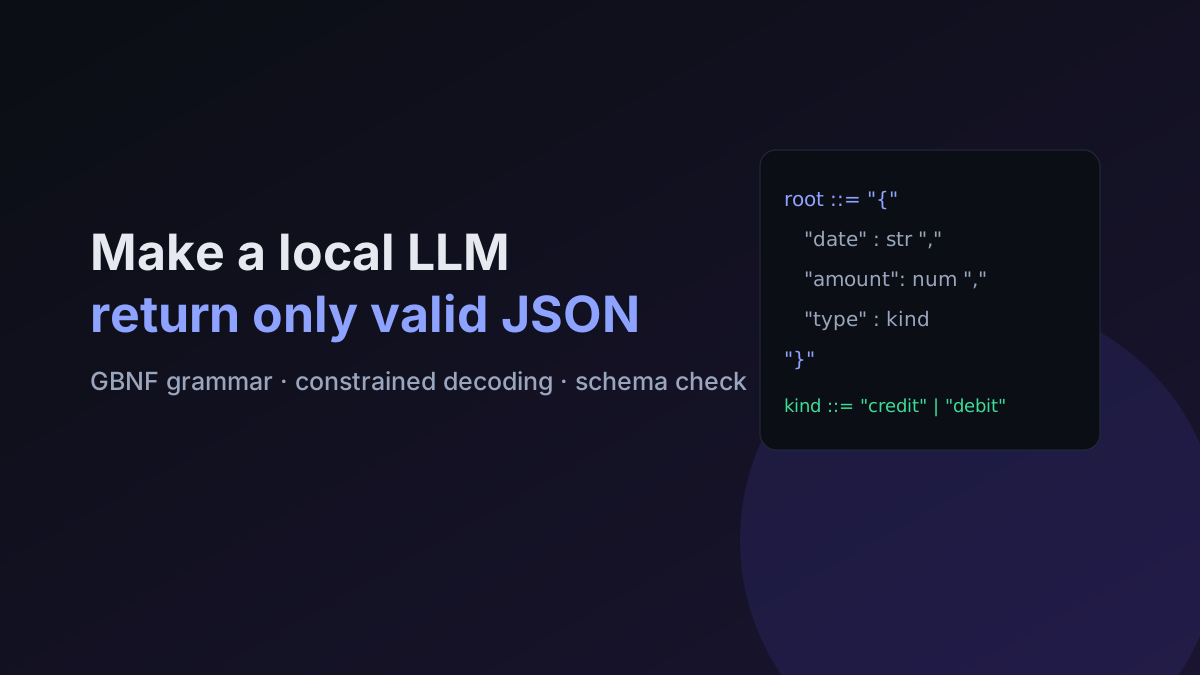
Say I want each record to be an object with a date, an amount, and a type that’s exactly credit or debit. A GBNF grammar pins that down:
root      ::= "{" ws "\"date\"" ws ":" ws string ws ","
                  ws "\"amount\"" ws ":" ws number ws ","
                  ws "\"type\"" ws ":" ws kind ws "}"
kind      ::= "\"credit\"" | "\"debit\""
string    ::= "\"" ([^"\\] | "\\" .)* "\""
number    ::= "-"? [0-9]+ ("." [0-9]+)?
ws        ::= [ \t\n]*
Note what this buys you beyond “it’s JSON”: type can only be credit or debit. The model can’t invent transfer or Credit . The enum is enforced by the decoder, not hoped for in a prompt.
Where it fits in the pipeline
In the finance analyzer, the local model is used only as a fallback extractor when rule-based parsing can’t handle a document. The flow is deliberately narrow:
document text ──▶ prompt + GBNF grammar ──▶ constrained decode ──▶ on-schema JSON ──▶ validate ──▶ recordsThree guards, not one:
- Fixed invocation path. There’s no chat UI — the model is called in exactly one place with one job. No free-form conversation to go off the rails.
- Grammar-constrained output. It can only emit valid, on-schema JSON.
- Post-decode validation. Even valid JSON gets a plausibility pass (real dates, non-zero amounts) before anything is stored.
Why bother when prompting “usually works”
Because “usually” is a reliability number, and on a long tail of messy inputs it’s worse than you think. Constrained decoding turns a probabilistic behavior into a structural guarantee:
- No parser babysitting. You delete the regex that strips
```jsonfences and the retry loop for malformed output. - Enums actually hold. Downstream code can trust the field is one of N values.
- Smaller models get usable. A 1.5B on-device model is far more reliable at format when format is enforced rather than learned — which is what makes the offline, on-device approach viable at all.
The general lesson
The pattern generalizes past JSON: when output feeds another program, constrain the output space instead of asking nicely. Grammars for structured text, state machines for tool calls, schemas validated at the boundary. Prompts are for intent; constraints are for guarantees. Use the prompt to say what you want, and the grammar to make everything else unreachable.