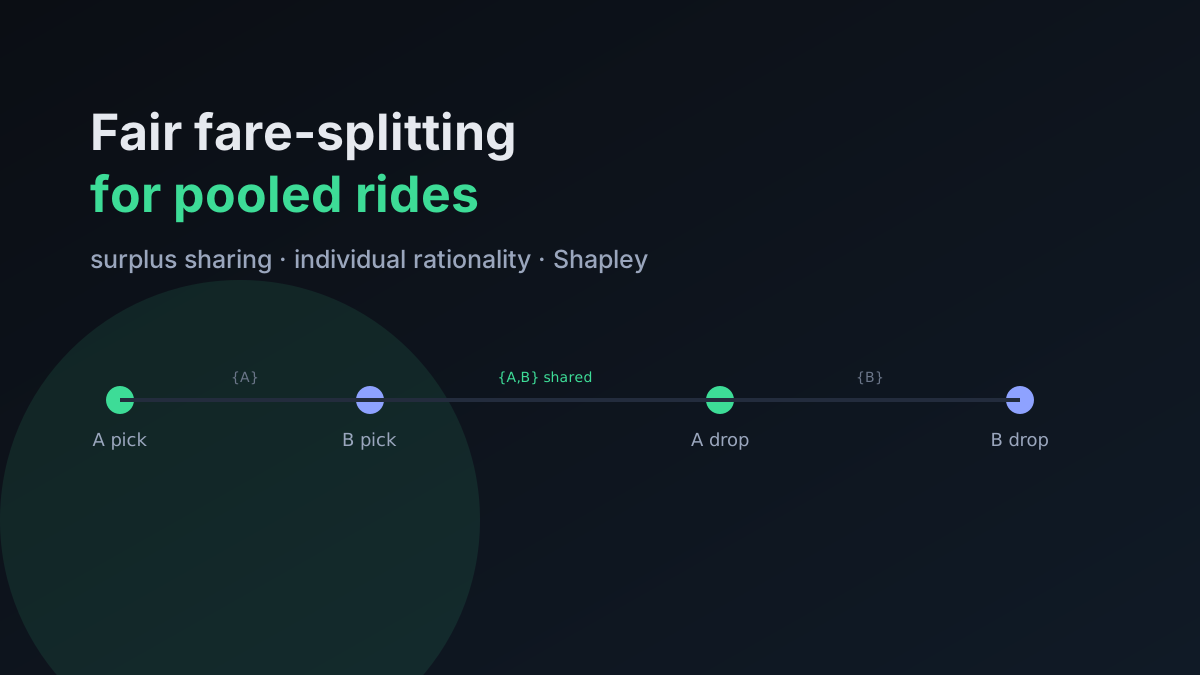
Sitting in a cab one day I started picking at a deceptively hard question: if two strangers share a ride, what’s the fair price for each? Splitting the meter sounds obvious until you work an example and watch it fall apart. This is how I reasoned my way to the fare model in Slipstream — and why the “obvious” split is wrong.
Model the world first
The city is a weighted directed graph: nodes are locations, edges carry a distance and a time. A pooled ride is an ordered list of stops (pickups and dropoffs). The key insight that makes fair splitting possible is the segment: the stretch of road between two consecutive stops, during which the set of on-board passengers never changes.
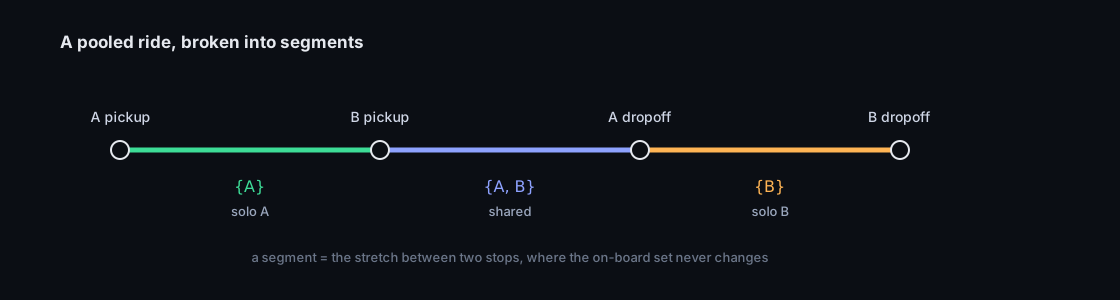
If you know the cost of each segment and who was aboard, you can attribute cost precisely. Shortest routes (and each rider’s solo baseline) come from Dijkstra over the graph.
Matching: only pool when it’s actually worth it
Slipstream is dynamic — A is already riding when B requests. The matcher keeps A’s stop order fixed and tries every valid placement of B’s pickup and dropoff, keeping the minimum-distance feasible plan. “Feasible” is three constraints:
- Capacity — never exceed the seats.
- Per-passenger detour — each rider’s distance stays within
solo × 1.3, so an existing rider isn’t dragged far out of their way. - Combined efficiency — total pooled distance ≤ the sum of solo distances.
That third one is the quiet hero. Without it, the planner can always “serve” B by finishing A’s trip and then driving to B — a back-to-back chain that’s technically feasible but pointless. Requiring the pooled route to be no longer than separate cars means we only pool when there’s real shared road.
The naive split, and why it fails
The obvious model: split each segment’s cost by how many people are aboard, and pay the driver the whole metered route.
Work the nested case — B is fully on A’s way (same destination). The car drives the exact same kilometres whether or not it picks up B. Splitting the fixed meter just redistributes a fixed pie among riders. The driver earns nothing extra for carrying a second person.
So why would a driver ever accept a pool? They wouldn’t. A fare model that doesn’t reward the behavior you want is a broken incentive, not just unfair.
The fix: share the surplus
The real value pooling creates is the redundant driving it avoids. Name it:
soloMetered(p) = perKm·soloDist(p) + perMin·soloTime(p)
surplus = Σ soloMetered(p)  −  totalMetered      // ≥ 0 by the combined constraint
surplus is the money saved versus sending separate cars. Split it three ways with shares that sum to 1 (default rider/driver/platform = 0.5 / 0.3 / 0.2):
- Riders keep their share of their own natural saving (so their fare is always ≤ solo).
- Driver is paid for road actually driven, plus a slice of the surplus — which is strictly positive whenever any road is shared. Now even fully-nested pools pay more.
- Platform keeps booking fees, commission, and its surplus share.
naturalSaving(p) = soloMetered(p) − rawShare(p)
charged(p)       = soloMetered(p) − RiderSurplusShare × naturalSaving(p)
driverEarnings   = totalMetered × (1 − commission) + DriverSurplusShare × surplus
Make fairness a tested property, not a vibe
“Fair” is easy to claim and easy to get wrong, so I encoded the guarantees as tests:
| Property | Guarantee |
|---|---|
| Individual rationality | total(p) ≤ soloFare(p) for every rider |
| Non-negative savings | savings(p) ≥ 0 |
| Driver-positive | driver earns strictly more than serving the anchor alone when road is shared |
| Conservation | Σ total(p) == driverEarnings + platformRevenue |
| Transparency | every charge traces to specific segments and occupancies |
Money conservation is the one I’d flag for anyone building pricing: it’s a single assertion (what riders pay == what driver + platform receive) that catches a whole class of “where did that cent go?” bugs.
Cross-check against the canonical fair answer
The segment split is simple and explainable — but is it fair in a formal sense? Game theory has a canonical answer: the Shapley value, where each player’s share is its average marginal contribution across all arrival orders.
φ_p = Σ over coalitions S without p:
        |S|!(n−|S|−1)!/n! × ( c(S ∪ {p}) − c(S) )
For the nested-overlap structure typical of corridor pooling, the simple segment split and the Shapley value coincide — a satisfying validation that the easy-to-explain rule is also the game-theoretically fair one. Shapley enumerates all 2^n coalitions, so I use it as an offline cross-check, not on the hot path.
The takeaway
The lesson I keep from this isn’t the fare formula — it’s the process:
- Find the structural primitive (here, the constant-occupancy segment) that makes the problem tractable.
- Work a small example by hand and watch the naive model break. The nested case exposed the incentive flaw instantly.
- Encode fairness as assertions (conservation, individual rationality) so they can’t silently regress.
- Validate the simple rule against the rigorous one — if they agree, you get to keep the explainable version.
Deliberately, this first cut has no live traffic, persistence, or UI. It’s a correct, well-tested, explainable engine to build on — which is exactly what I wanted first.