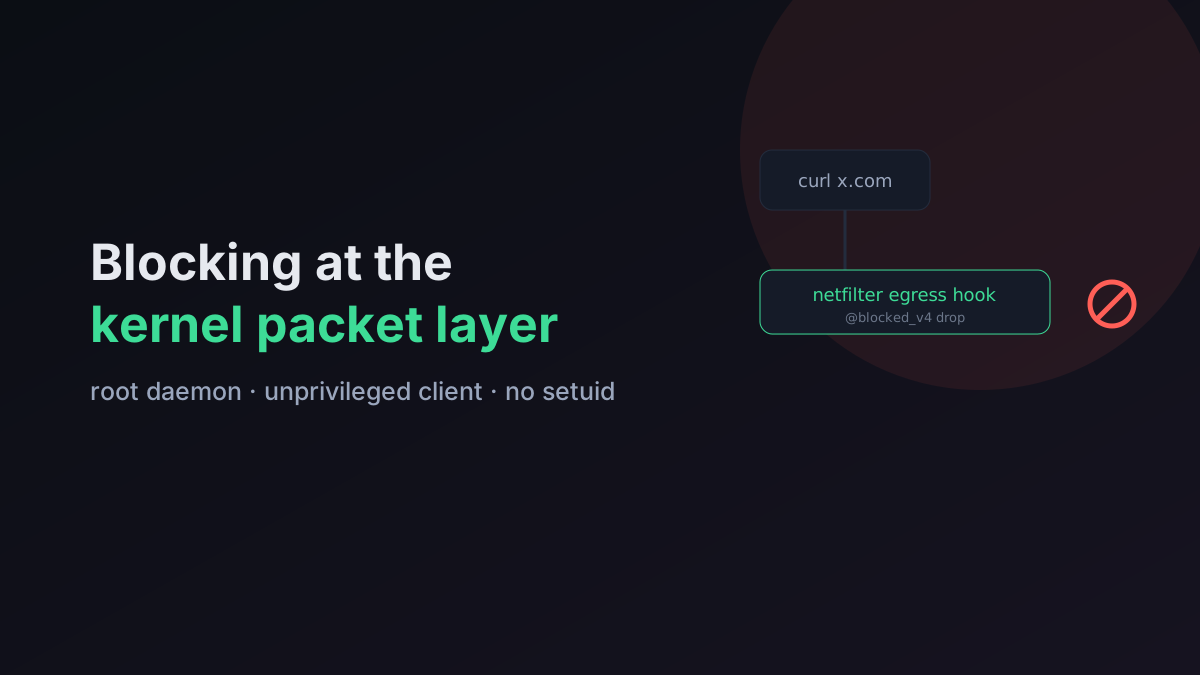
I wanted something that sounds simple: block a list of websites on a Linux box. The moment you take it seriously, it stops being simple — and the interesting part is where you enforce the block and who is allowed to change it. This is the design walk-through for webblock, and more importantly, the reasoning behind each decision.
Status: in progress. webblock is an active work-in-progress project — the design below reflects the current implementation and is still evolving (see the project page). Treat it as a living design rather than a finished release.
Start from the threats, not the features
The naive approach is to drop entries into /etc/hosts or a DNS blocklist. It’s a trap. The requirements I actually cared about were:
- The block applies to every client, not just browsers — including
curl, includingcurl http://<ip>(a raw IP) andcurl --resolvetricks. - Root’s rules apply to everyone; a user’s rules apply only to that user and stay private from other non-root users.
- No setuid binary anywhere.
Each of those quietly kills an “easy” option:
/etc/hosts/ DNS-only blocking is system-wide only and trivially bypassed by hitting the IP directly. Out.- Per-user privacy means a plain shared file won’t do — one user must not read another’s list.
- “No setuid” rules out the classic trick of a root-owned binary anyone can run.
Write down the constraints that eliminate options before you start building. Half the architecture falls out of “what does this requirement forbid?”
Decision 1: enforce at the IP layer, in the kernel
To catch curl http://<ip>, you have to block by destination IP at the packet layer — a kernel egress filter that drops packets regardless of which process or which name resolution produced them. So a domain block becomes: resolve the domain to IPs, drop those IPs, and re-resolve periodically to track CDN drift.
That has a known limitation I accepted up front: it’s IP-level, not L7, so domains that share an IP with allowed content would over-block. For the stated use case, fine.
Decision 2: a root daemon + an unprivileged client
“No setuid” pushes you toward a privileged daemon that owns the firewall, plus an unprivileged CLI that just sends it requests over a Unix socket:
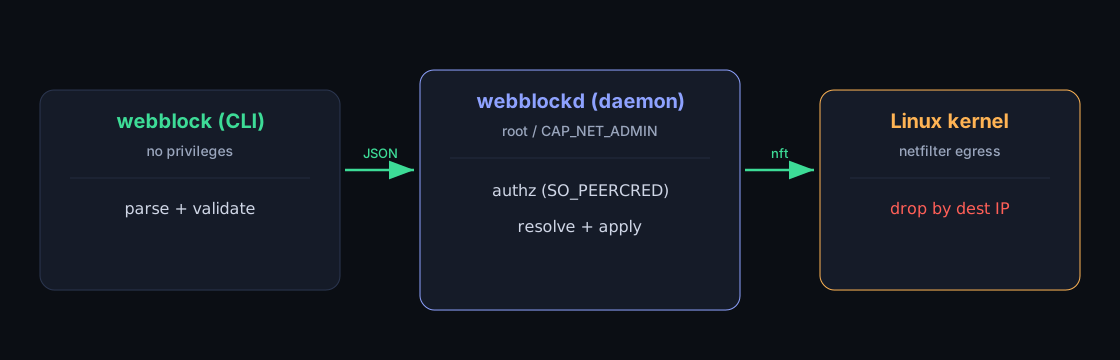
Why this shape wins: there’s exactly one narrow privileged surface. Compromising the CLI grants nothing — it holds no privileges and makes no policy decisions. The daemon runs with just CAP_NET_ADMIN (not full root powers), locked down further by the systemd unit (NoNewPrivileges, ProtectSystem=strict, ProtectHome, PrivateTmp).
The alternatives I rejected, and why:
| Option | Why not |
|---|---|
| setuid-root binary | Every invocation runs fully root — one bug = full compromise |
| sudoers / polkit rules | Still full root per call; trusts SUDO_UID; fragile rules |
CAP_NET_ADMIN filecap on a binary |
Privileged on every run; cap doesn’t protect per-user file privacy |
Decision 3: identity comes from the kernel, never the client
Here’s the subtle bit that makes per-user policy trustworthy. The request protocol has no uid field. If the client could say “I am uid 1000,” any user could lie. Instead the daemon reads the caller’s identity from the socket itself via SO_PEERCRED, which the kernel fills in and the client cannot forge.
Request{ Version, Action, Domains[], IPs[], TargetUser } // note: no uidAuthorization then becomes a tiny, centralized rule:
- uid 0 → full access (global list, or any user via
--user). - any other uid → only its own scope; it can never read or write another user’s list.
That single source of truth — “identity is kernel-verified, decisions live in one place” — is what lets me reason about the security of the whole thing.
Decision 4: make the data plane O(1) in list size
A blocker is useless if it slows down the network. Two choices keep the packet path fast:
- Hash sets (nftables named sets / ipset
hash:ip) give ~O(1) membership checks, so a 10,000-entry blocklist costs the same per packet as a 10-entry one. - Per-user matching via a verdict map keyed on the socket-owner uid (
meta skuid vmap), so the per-packet cost is one O(1) map lookup regardless of how many users have lists — not a linear scan of per-user rules.
# global drops
ip daddr @blocked_v4_global drop
# per-user: one map lookup, then jump to that user's chain
meta skuid vmap { 1000 : jump uid_1000, 1001 : jump uid_1001 }
The control plane matters too: every apply is atomic (one nft -f transaction, or the ipset create/swap/destroy idiom), so there’s never a window where a half-applied ruleset leaks traffic. And DNS resolution runs off the lock, concurrently, so a slow refresh never blocks an interactive add.
Decision 5: fail safe, not open
A blocker must never silently unblock something. So:
- A transient DNS failure retains the previous IPs for that domain rather than dropping the block.
- On boot, persisted lists are reconciled into the live firewall, so blocks survive reboots and daemon restarts.
- If a firewall apply fails, the mutate request returns an error and — because apply is atomic — the prior ruleset stays in effect.
High-level design (HLD)
Pulling those decisions together, the system is two processes split across a privilege boundary, with the kernel as the actual enforcement point. The whole architecture exists to keep one small surface privileged and everything else powerless.
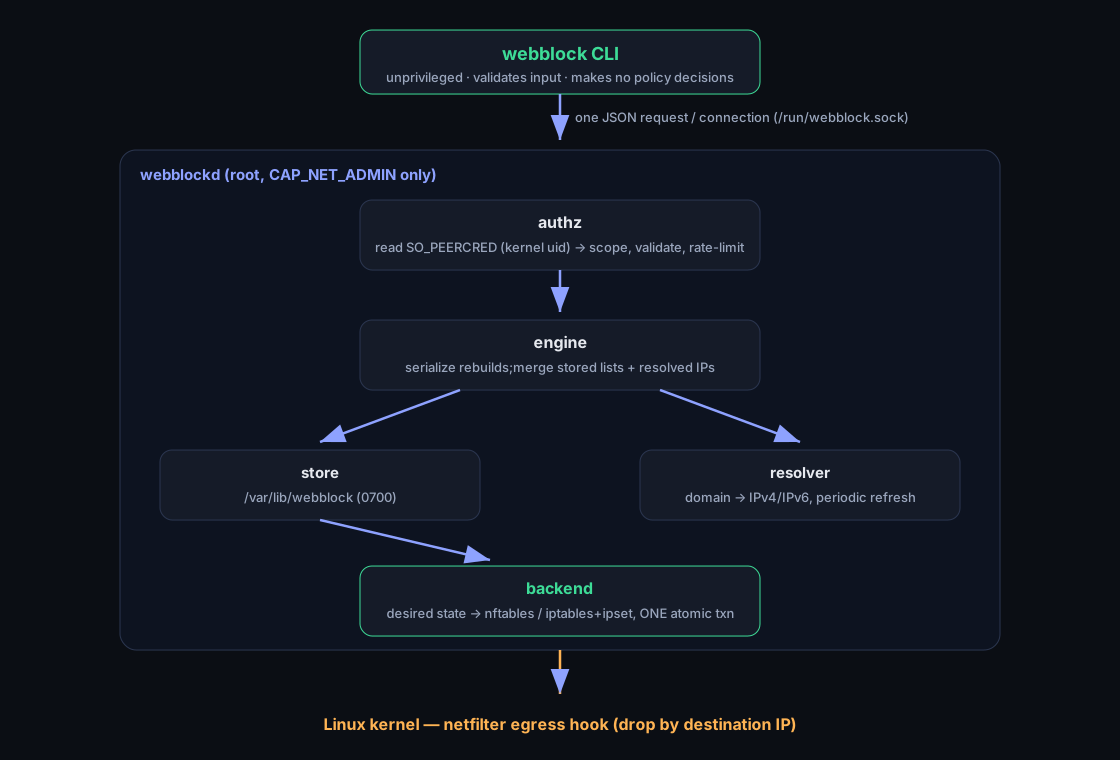
| Component | Process | Privilege | Responsibility |
|---|---|---|---|
webblock (CLI) |
client | none | Parse/validate args, send one JSON request, render the response |
webblockd |
daemon | root (CAP_NET_ADMIN) |
Own the firewall + config; authenticate, resolve, apply |
authz |
in daemon | — | Read SO_PEERCRED, enforce per-user scope, validate, rate-limit |
engine |
in daemon | — | Serialize rebuilds; merge store + resolved IPs; drive the backend |
resolver |
in daemon | — | Resolve domains to IPv4/IPv6 with a timeout; refresh periodically |
store |
in daemon | — | Atomic persistence of blocklists per scope (root-owned, 0700) |
backend |
in daemon | — | Translate desired state into nftables/iptables rules, atomically |
The request protocol is deliberately tiny and versioned, and — the crucial part — carries no uid field, because identity comes from the kernel, not the caller:
Request{ Version, Action, Domains[], IPs[], TargetUser }   // no uid — taken from SO_PEERCRED
Response{ OK, Error, Message, Views[], Status }
A single add walks the whole stack:
- user runs
webblock --add --name x.com - CLI validates and sends
{Version, Action: add, Domains: [x.com]}(no uid) - authz reads the uid via
SO_PEERCREDand authorizes the requested scope - engine resolves
x.comto IPs, persists to the store, rebuilds the ruleset - backend applies one
nfttransaction atomically - daemon -> CLI returns
{OK: true}; the CLI prints the result
A fuller LLD (the IPC module, the per-user verdict-map layout, the full alternatives table) lives in the project’s design doc; this is the shape you need to reason about its security.
What I’d take to the next project
The shape here generalizes far beyond blocking websites:
- Let the constraints prune the design. “No setuid” and “per-user privacy” did most of the architectural work.
- One privileged surface, kernel-verified identity, centralized authorization. That’s a reusable pattern for any local privileged tool.
- Design the data plane for O(1) early — picking hash sets and a verdict map up front was cheaper than retrofitting performance later.
- Default to fail-safe. For a security tool, the safe failure mode is non-negotiable.
There’s a fuller HLD/LLD (component breakdown, sequence diagrams, the full alternatives table) in the project’s design doc. The thread running through all of it: decide where trust lives before you write a line of enforcement.