Most online Swagger/OpenAPI editors work the same way: you paste a spec, it goes to a server, and you get a preview back. Convenient — until the spec describes an internal or unreleased API that really shouldn’t leave your network. That gap is why I built swagger-view, a VS Code extension that renders the spec entirely locally.
This is a journal entry, not a tutorial — here’s what building it taught me.
“No callbacks” is a feature
I expected local-first to be a limitation I’d apologize for. Instead it became the whole pitch: your spec is read from disk, parsed locally, and rendered locally. Close the editor and nothing has gone anywhere. For anyone handling sensitive specs, that’s the headline.
Owning the parse unlocks more than preview
Because the extension already understands the spec, it can do more than draw it:
- Find unused definitions, schemas, parameters and responses.
- Jump to the exact location of any item or endpoint.
- Delete unused definitions safely, one at a time or in bulk.
None of that needs a server. The data was already in memory.
Refactoring toward SOLID paid off
The first version mixed parsing, UI, and file I/O together. Splitting it into clear service boundaries made the cleanup features possible without fear — each piece could change independently. A good reminder that architecture is a feature-enabler, not ceremony.
Local-first isn’t always the easiest path, but for developer tools handling sensitive specs, it’s the right default.
The architecture (HLD)
Local-first didn’t mean “simple” — it meant the architecture had to do all the work that a server normally would, in-process. The extension splits into two runtimes: the extension host (Node/TypeScript, where parsing and analysis live) and a webview (the sandboxed Swagger UI that only renders). Nothing else is in the picture — no backend, no network.
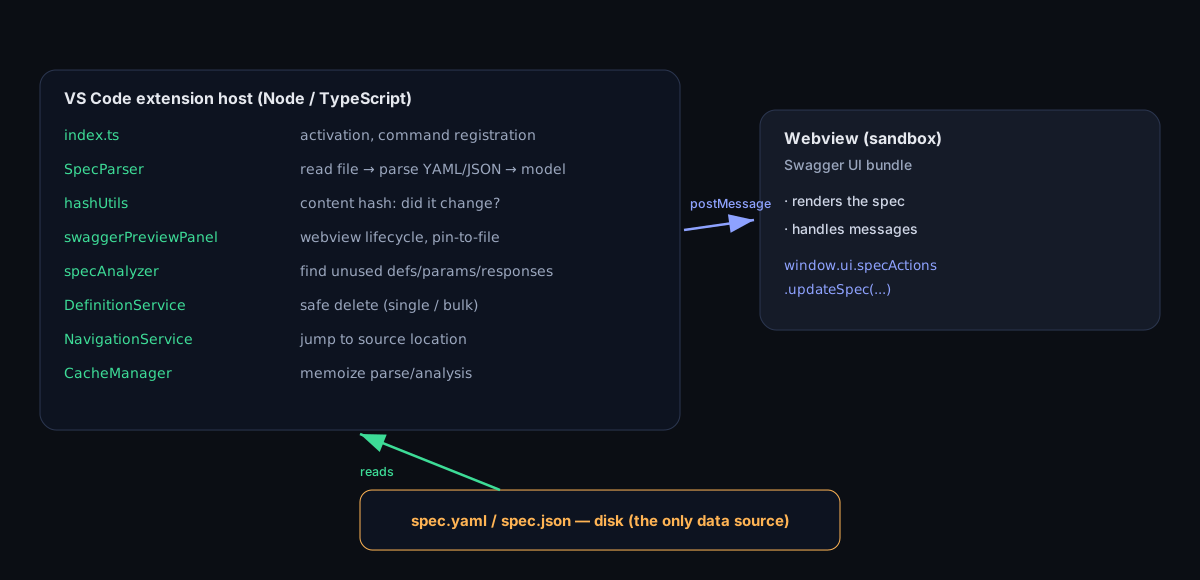
| Component | Responsibility |
|---|---|
index.ts |
Activation; registers commands; wires the document-change listener. |
SpecParser |
Reads the file and parses YAML/JSON into an in-memory OpenAPI model. The single source of truth everything else reads from. |
hashUtils |
Computes a content hash so a no-op edit can short-circuit before re-rendering. |
swaggerPreviewPanel |
Owns the webview’s lifecycle, the pin-to-file binding, and the postMessage bridge to Swagger UI. |
specAnalyzer |
Walks the model to find unused schemas, parameters, and responses. |
DefinitionService |
Deletes unused definitions safely — one at a time or in bulk. |
NavigationService |
Maps any node back to its exact line/column for jump-to-source. |
CacheManager |
Memoizes parse/analysis output so repeated renders stay cheap. |
The update flow
The “live preview” everyone expects is a small pipeline, and keeping each hop honest is what makes it feel instant:
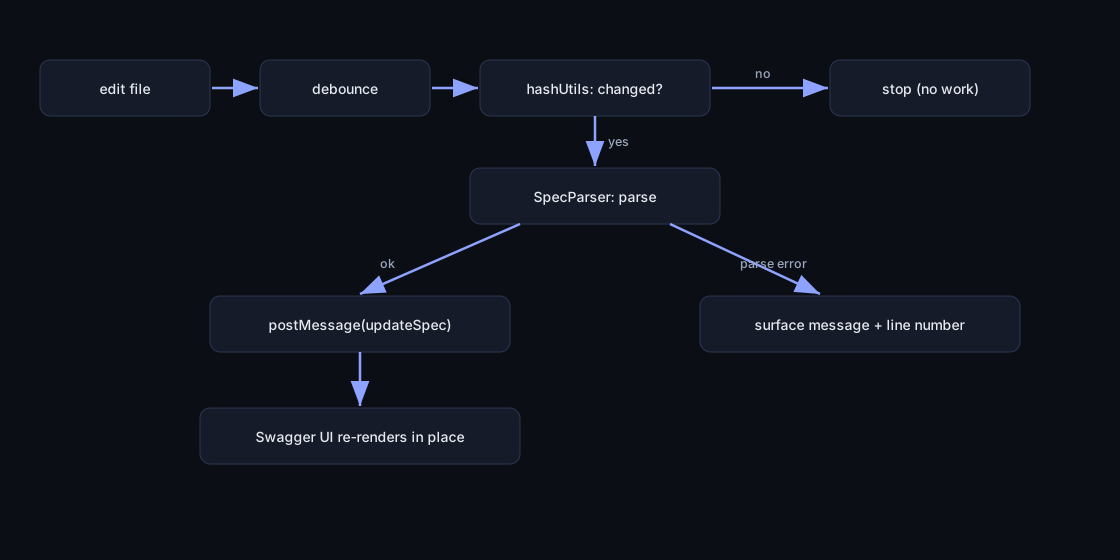
Two architectural properties fall out of this shape:
- The model is computed once and reused. Preview, unused-definition detection, deletion, and navigation are all just readers of the same parsed model — which is exactly why none of them needs a server. The data is already in memory.
- The boundary is a message bus. The host owns truth; the webview only renders and posts intents back. That clean split is what made it safe to add bulk-delete and jump-to-source later without destabilizing the preview.
What I’d revisit
The honest weak spot is the host↔webview contract: a subtle data-shape mismatch there (passing the wrong type into Swagger UI’s update call) was behind a “preview won’t refresh” bug. If I rebuilt it, I’d put a single typed serializer at that boundary so the contract is enforced in one place rather than implied at each postMessage.
What’s next
A few people have asked for a marketplace listing instead of building the .vsix by hand. That’s the next chunk of work — packaging and release, ideally automated the same way I automate releases elsewhere.