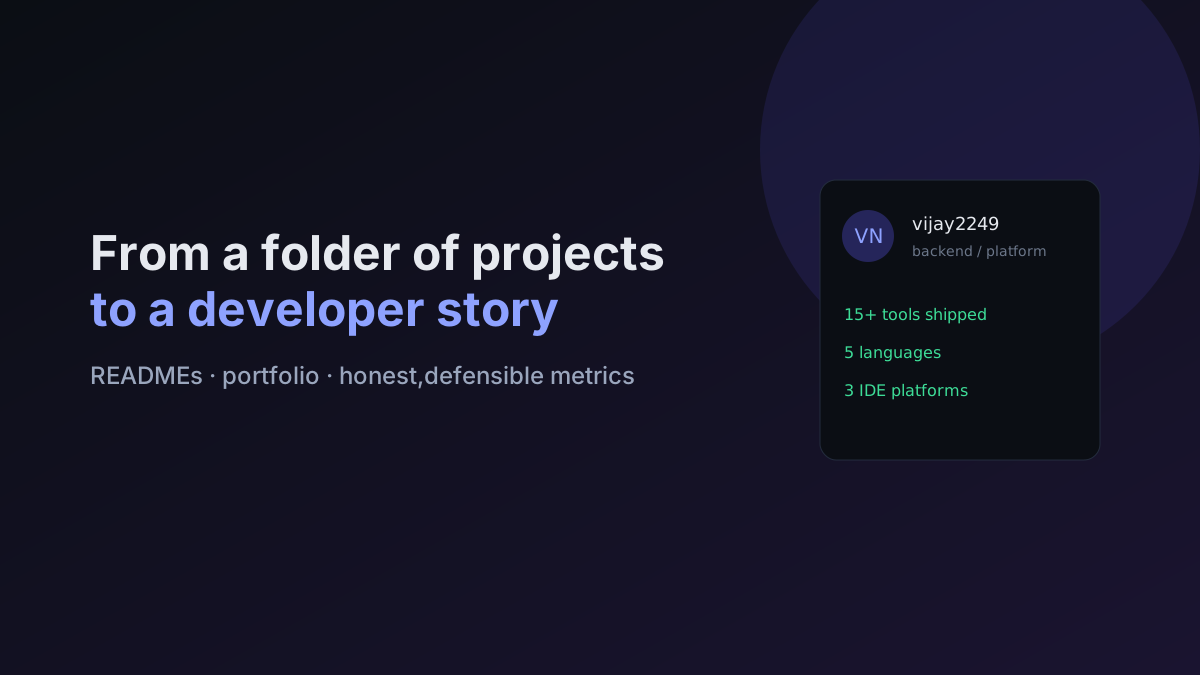
I’m a Backend and Platform Engineer; writing about my work doesn’t come as naturally as building it. But a pile of repos isn’t a story. This is what I learned turning scattered projects into a coherent presence — GitHub READMEs, an org profile, and a portfolio — and how I handled the trickiest part: putting numbers on my work without lying to myself.
A README is a landing page, not a changelog
The reflex is to dump configuration and a feature list. But a repo’s README is the first (often only) thing a visitor reads, so it has a job: in fifteen seconds, answer what is this, who is it for, and why should I care? Structure that worked:
- One-line what it is and the problem it solves.
- A small “why” — the niche it fills that nothing else does.
- Then install/usage, screenshots, and details.
I write the top of every README as if the reader will bounce after one paragraph — because most do.
An org profile is positioning, not a repo list
For an organization page (the special .github/profile/README.md that renders on the org home) the goal is different: it should state what the org stands for and let the repos hang off that. For a privacy-focused org, the through-line was simple — “applications that don’t track users” — and every project read as evidence for that stance rather than a standalone entry.
The lesson: a profile’s job is to give people a lens. Lead with the position; let the work support it.
Choosing a stack for the site (again, fit first)
For the org website and my portfolio I ran the same comparison I always do:
- Plain HTML/CSS/JS — zero build, perfect for a small site that rarely changes.
- React + Vite — worth it only if the site becomes app-like (filters, dashboards).
- Astro — component authoring with near-zero shipped JS; the sweet spot for a fast, SEO-friendly, mostly-static site.
There’s no universally right answer — only the right answer for the size and lifespan of the thing. Don’t reach for a framework a brochure site won’t use.
The hard part: quantifying impact honestly
A portfolio without numbers feels weak; a portfolio with invented numbers is worse. My rule was that every metric has to trace to something real and be defensible in conversation. Concretely, I split claims into tiers:
- Tool-internal benchmarks I measured — e.g. “~50% fewer file reads,” “sub-second flow updates,” “full rule parity with zero server round-trips.” Real, but I label them as tooling metrics, not team-wide productivity stats, and I’m ready to explain how they’re measured.
- Countable facts — number of tools shipped, languages used, IDE platforms targeted, internal automations built. Easy to stand behind because they’re just counts.
- Order-of-magnitude estimates — phrased as estimates (“a large microservice estate”), not false precision.
The test for any number on your résumé: can you explain exactly where it comes from, out loud, without flinching? If not, soften it or cut it.
The most powerful metrics are genuine team-level outcomes (review time saved, defect rate, coverage improvement, onboarding time). If you have those, lead with them. If you only have tool-internal ones, cite them — but label them honestly. Overclaiming is a one-interview strategy.
Keep one source of truth
I kept the résumé in two synced forms (Markdown and HTML) and the portfolio metrics aligned with both. The annoyance of syncing three places taught me the obvious fix: one canonical list of facts, rendered into each surface, so a number can’t be right in one place and stale in another.
What I took away
- Write the README top for the reader who bounces — what, who, why, fast.
- An org profile is a lens; lead with the position, let repos support it.
- Pick the site stack by size and lifespan, not fashion.
- Tier your metrics (measured / counted / estimated) and label each honestly.
- Keep one source of truth for the facts about yourself.
Telling your own story well is a skill worth practicing.