This is the implementation-level companion to the AlgoRythm overview.
It’s open on GitHub — a growing learning reference rather than a framework.
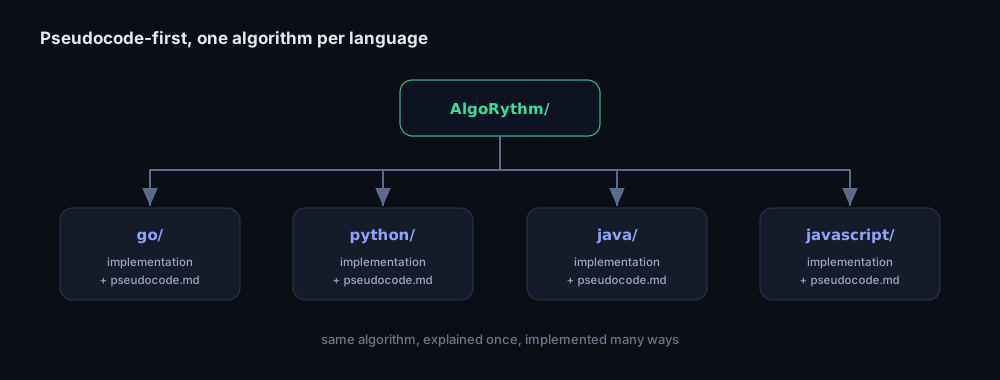
The convention
There’s no build system or runtime here — the “architecture” is a deliberately simple convention, and the discipline is what makes it useful:
- Explain once, in pseudocode. Each algorithm leads with language-neutral pseudocode that captures the idea — the invariant, the recurrence, the loop or recursion — without any one language’s syntax getting in the way.
- Implement per language. The same algorithm is then written across languages (Go, Python, Java, JavaScript), kept structurally close so they can be read side by side.
- Keep the layout flat and predictable. Consistent structure is what makes the collection easy to keep adding to over time.
What the comparison teaches
Leading with pseudocode separates the algorithm from its expression, so the implementations become a study in how each language says the same thing:
- Data structures — slices vs. lists vs. arrays, and how each affects the code.
- Iteration vs. recursion — idiomatic loop style and recursion limits per language.
- Error and edge handling — how each language deals with empty inputs, bounds, and overflow.
- Complexity in practice — the pseudocode states the Big-O; the implementations show what it costs to actually hit it.
Scope
This one is intentionally experimental and informal — the goal is a clear, comparable reference I keep extending while drilling DSA, not a finished product. If you’re skimming it, read the pseudocode first, then pick the language you think in and compare.