This is the implementation-level companion to the webblock overview.
It walks the IPC protocol, the daemon internals, the firewall backends, and the performance and failure model. The conceptual story lives in the blog post Blocking websites at the kernel layer on Linux.
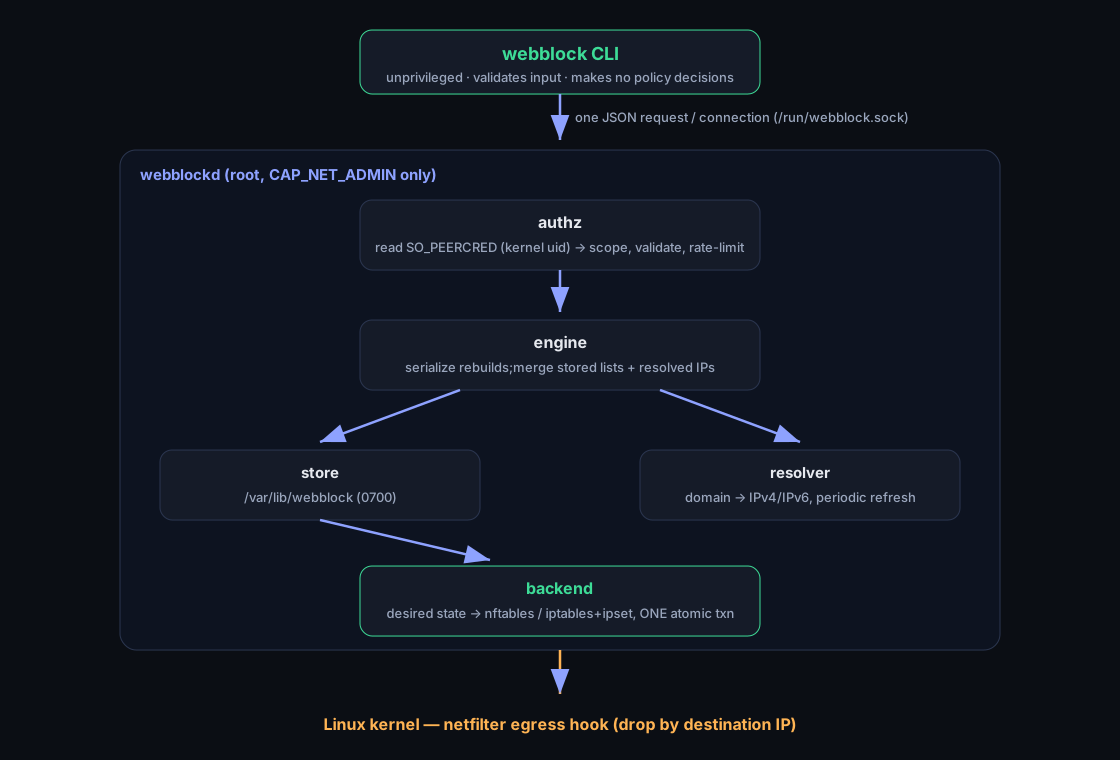
Repository layout
The codebase is split so that the only privileged code is small and obvious:
cmd/webblock        unprivileged CLI client
cmd/webblockd       privileged daemon, split by concern:
                      main.go, config.go, identity.go, server.go (transport),
                      ratelimit.go, authz.go, dispatch.go, handlers.go, engine.go
internal/proto      JSON IPC types (versioned)
internal/store      config persistence (/var/lib/webblock)
internal/validate   normalization + validation
internal/backend    Backend interface + nftables and iptables implementations
internal/resolver   domain -> IP resolution (concurrent)
deploy/             systemd unit
The IPC protocol
The CLI and daemon speak a tiny, versioned request/response over a Unix domain socket — one request per connection. The single most important property: the request carries no uid field. Identity is read from the kernel, never asserted by the client.
// internal/proto
Request{ Version, Action, Domains[], IPs[], TargetUser }   // no uid
Response{ OK, Error, Message, Views[], Status }

// Actions: add | remove | show | status
Every Request carries Version; the daemon rejects versions newer than it understands. The CLI does client-side normalization and validation for fast feedback, then sends one newline-terminated JSON request and reads one response. It holds no privileges — it is purely a messenger and renderer.
Daemon internals (split by concern)
webblockd is deliberately decomposed so permission decisions live in exactly one place:
| File | Responsibility |
|---|---|
main.go |
Flags into Config, backend detection, startup reconcile, signals, launches refresh loop + socket server |
identity.go / peercred_linux.go |
SO_PEERCRED — the kernel-verified caller identity |
server.go |
Transport: accept, read peer creds, decode one request, rate-limit, dispatch (no per-action logic) |
ratelimit.go |
Per-uid fixed-window limiter |
authz.go |
ResolveScope + access control — the only place permission decisions live |
dispatch.go |
Routes an action to its handler; enforces the protocol version check |
handlers.go |
The add/remove/show/status handlers + authoritative input validation |
engine.go |
The single serialization point for firewall rebuilds; holds the resolved-address cache |
Kernel-verified identity and authorization
The daemon reads the caller’s uid/gid from the socket via SO_PEERCRED, which the kernel fills in and the client cannot forge. Authorization is then a small, central rule:
request received
  -> valid action?            no  -> error: unknown action
  -> show                     -> build views by role
  -> add/remove + caller root?
       no  -> target empty/self?  no  -> error: permission denied
                                  yes -> scope = own uid
       yes -> target set?  no/global -> scope = global
                           name/uid  -> scope = that user
  -> normalize + validate -> store.Mutate -> engine.Rebuild -> backend.Apply
uid 0 gets full access (global list, or any user via --user); any other uid is confined to its own scope and can never read or write another user’s list. On --show, a non-root caller only ever receives their own list plus the global list (read-only) — other users’ lists are never returned.
Storage
Config is root-owned under /var/lib/webblock (mode 0700), one JSON file per scope:
/var/lib/webblock/
  global.json          # root-managed, applies to all users
  users/<uid>.json     # per-user, private
Writes are atomic — marshal to a temp file, chmod 0600, then rename. Mutate(scope, fn) loads, applies a closure, and saves under a single lock; entries are normalized to sorted, de-duplicated sets. Filesystem permissions are defense-in-depth; privacy is enforced centrally by the daemon.
The data plane
IP-layer enforcement needs IPs, so the resolver turns domains into addresses and the backend programs the kernel. Two backends implement one interface (Name(), Apply(State), Teardown()), selected by probing nft list ruleset and falling back to iptables+ipset.
nftables (primary) uses one inet webblock table rebuilt per apply as a single atomic nft -f transaction. Per-user matching is the clever part — a verdict map keyed on the socket-owner uid means the per-packet cost is one O(1) map lookup regardless of how many users have lists, not a linear per-user rule scan:
# per-uid regular chains
chain uid_<uid> { ip daddr @blocked_v4_uid_<uid> drop; ip6 daddr @blocked_v6_uid_<uid> drop }
# output chain
ip  daddr @blocked_v4_global drop
ip6 daddr @blocked_v6_global drop
meta skuid vmap { 1000 : jump uid_1000, 1001 : jump uid_1001 }
iptables + ipset (fallback) uses hash:ip sets per scope/family and a WEBBLOCK chain hooked from OUTPUT. An apply uses a constant number of subprocesses regardless of list size: one ipset restore swaps every set atomically (create/fill/swap/destroy), and one iptables-restore --noflush per family rebuilds just the WEBBLOCK chain.
Performance model
With N = blocked entries, U = users with lists:
- O(1) in list size. Hash sets give ~O(1) membership, so a 10,000-entry list costs the same per packet as a 10-entry one.
- O(1) in user count. The
meta skuidverdict map is a single lookup, not a per-user scan. - Incremental apply. When only addresses change (the common case) the backend applies element add/delete deltas instead of rebuilding; a delta error self-heals into a full rebuild.
- DNS off the lock. Domains resolve concurrently (bounded by
ResolveConcurrency) outside the engine lock, which is held only to re-read the store and apply — so a slow refresh never blocks an interactiveadd. Reads (--show/--status) bypass the lock entirely. - TTL-aware refresh. Resolved addresses carry a freshness window (
DNSCacheTTL); the refresh loop re-resolves only entries past their TTL instead of everything each tick.
Validation and limits
internal/validate normalizes a pasted URL down to a bare hostname (lowercases, strips scheme/userinfo/path/port/trailing dot), runs RFC-style label checks, rejects bare IPs on the domain path (use --ip), and canonicalizes IPv4/IPv6. Requests are capped (MaxItemsPerRequest = 256) with domain/label length limits, so a malformed or oversized request is rejected before it ever touches the firewall.
Failure handling
- No backend at startup: the daemon fails fast with a clear error.
- Transient DNS failure: logged; the previous resolved IPs are retained so a domain is never silently unblocked.
- Firewall apply failure: the mutate returns an error; because apply is atomic, the prior ruleset stays in effect.
- Restart: rules are intentionally left in place on shutdown; on next start the store is reconciled back into the firewall, so blocks survive reboots.
Security model, in one list
- Single privileged surface — only
webblockdis privileged; compromising the CLI grants nothing. - Unforgeable identity — uid/gid from
SO_PEERCRED, not the request. - Central authorization — one place decides scope access.
- No setuid anywhere — avoids the “every invocation runs as root” risk.
- Least privilege at runtime — the systemd unit restricts the daemon to a
CAP_NET_ADMINbounding set withNoNewPrivileges,ProtectSystem=strict,ProtectHome,PrivateTmp, and a narrowReadWritePaths. - Auditing — every mutation is logged with requesting uid, action, scope, and items.
Known limitations
- IP-based enforcement can briefly lag a CDN address rotation until the next re-resolution.
- Per-user matching keys off the socket-owner uid, so traffic from a root-owned helper on a user’s behalf is attributed to that helper.
- No L7 inspection — destinations sharing an IP with allowed content would over-block, which is acceptable for the stated use case.