This is the implementation-level companion to the swagger-view overview.
The source is open under WeDontTrack (GPL-3.0); the design story is in shipping a local-first dev tool.
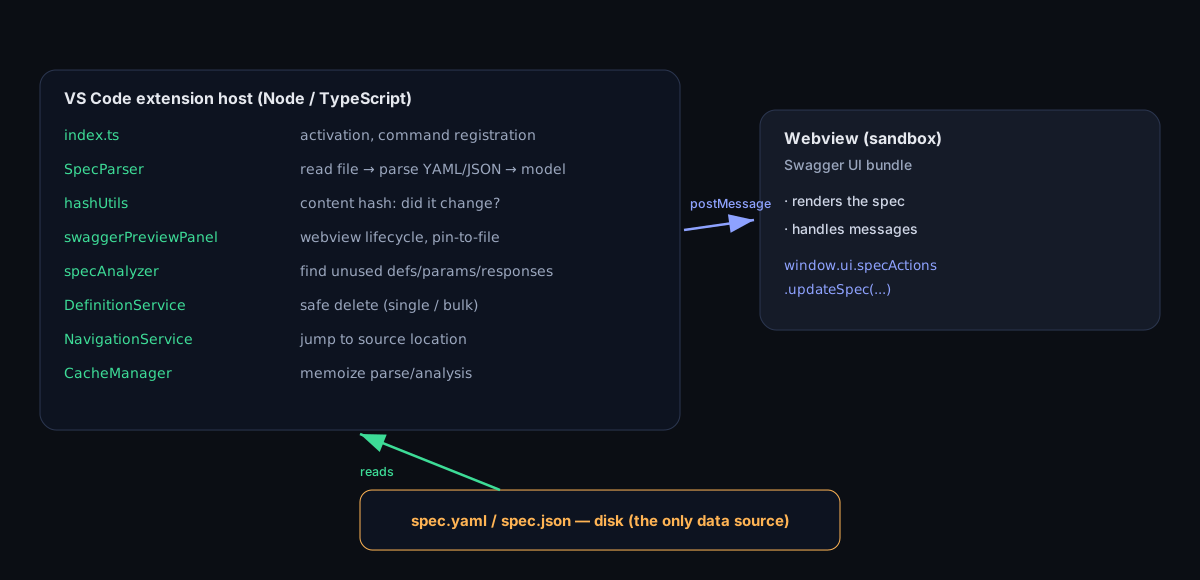
Source layout
The extension is split into a thin host plus a set of single-responsibility services:
src/
  index.ts                 # activation, command registration, change listener
  swaggerPreviewPanel.ts   # webview lifecycle, pin-to-file, postMessage bridge
  specAnalyzer.ts          # find unused defs/params/responses
  hashUtils.ts             # content hashing for change detection
  constants.ts  types.ts  interfaces.ts  utils.ts
  services/
    SpecParser.ts          # read + parse YAML/JSON -> in-memory OpenAPI model
    CacheManager.ts        # memoize parse/analysis results
    DefinitionService.ts   # safe delete (single / bulk)
    NavigationService.ts   # map any node back to its source location
Two runtimes, one source of truth
There are exactly two runtimes: the extension host (Node/TypeScript) where all parsing and analysis live, and a webview (the sandboxed Swagger UI) that only renders and posts messages. Disk is the single data source — there is no backend and no network.
The host owns truth; the webview is a pure view. They talk over a postMessage bridge: the host posts updateSpec, the webview posts back navigation/source requests. Because the parsed model is computed once and cached, preview, unused-definition detection, deletion, and navigation are all just readers of the same model — which is exactly why none of them needs a server.
The update pipeline
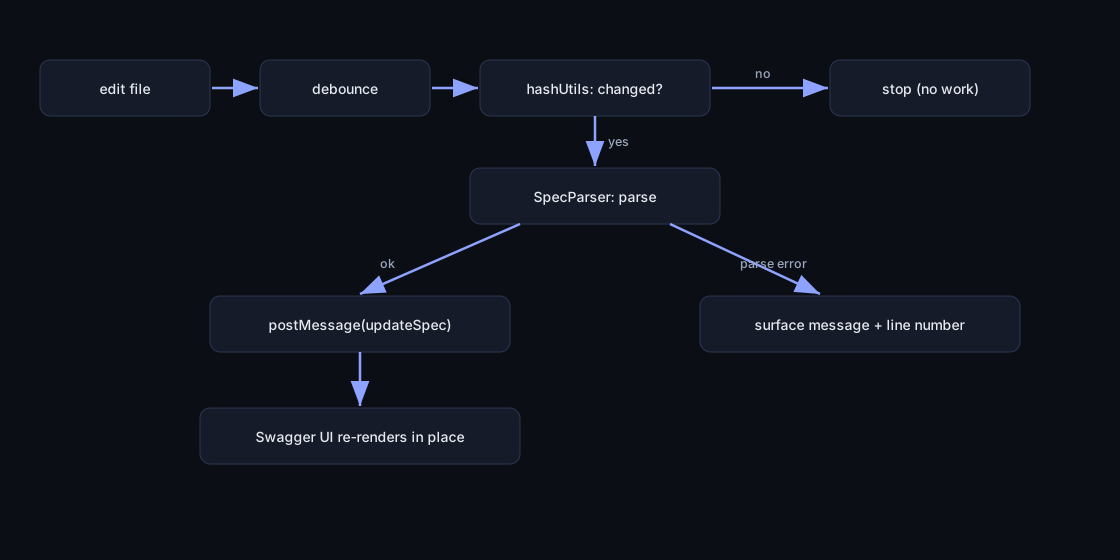
The “live preview” is a small pipeline where each hop is kept honest:
- A document edit is debounced so rapid typing doesn’t thrash the parser.
hashUtilscomputes a content hash; if it’s unchanged, the pipeline short-circuits before doing any work.- On a real change,
SpecParserparses the file into the in-memory OpenAPI model. - On success the host posts
updateSpecand Swagger UI re-renders in place; on a parse error it surfaces the message and the line number instead of blanking the preview.
CacheManager memoizes parse/analysis output keyed on that hash, so repeated renders of an unchanged spec stay cheap.
Unused-definition detection
Because SpecParser already produced the full model, specAnalyzer walks it to find definitions, schemas, parameters, and responses that are declared but never referenced. Results drive the preview’s banner (unused vs. total), color-coded badges per component type, and an expandable list. Each entry is clickable — NavigationService maps the node back to its exact line/column so a click jumps straight to the declaration, and every API path gets a “Source” button that jumps to the specific HTTP method.
Transaction-safe deletion
Deleting unused definitions — one at a time or in bulk — is the operation most likely to corrupt a file, because removing a node shifts the line numbers of everything below it. DefinitionService applies edits bottom-to-top, so earlier deletions never invalidate the source ranges of later ones. The deletions are computed from the same model the preview and analyzer use, so what you see flagged is exactly what gets removed.
Why this shape holds up
- The model is computed once and reused — preview, analysis, deletion, and navigation are all readers, which is what makes a server unnecessary.
- The boundary is a message bus — the host owns truth, the webview only renders, so the sandbox stays a sandbox.
- Local-first is a property, not a feature — reading from disk and parsing in-process is what lets the whole thing work with zero callbacks, which matters when the spec describes an internal or unreleased API.