This is the implementation-level companion to the Code Insights overview.
It’s an internal tool, so this is a scrubbed, generic version of the design — no employer-specific details. The conceptual story is in Coverage and offline static analysis in the editor.
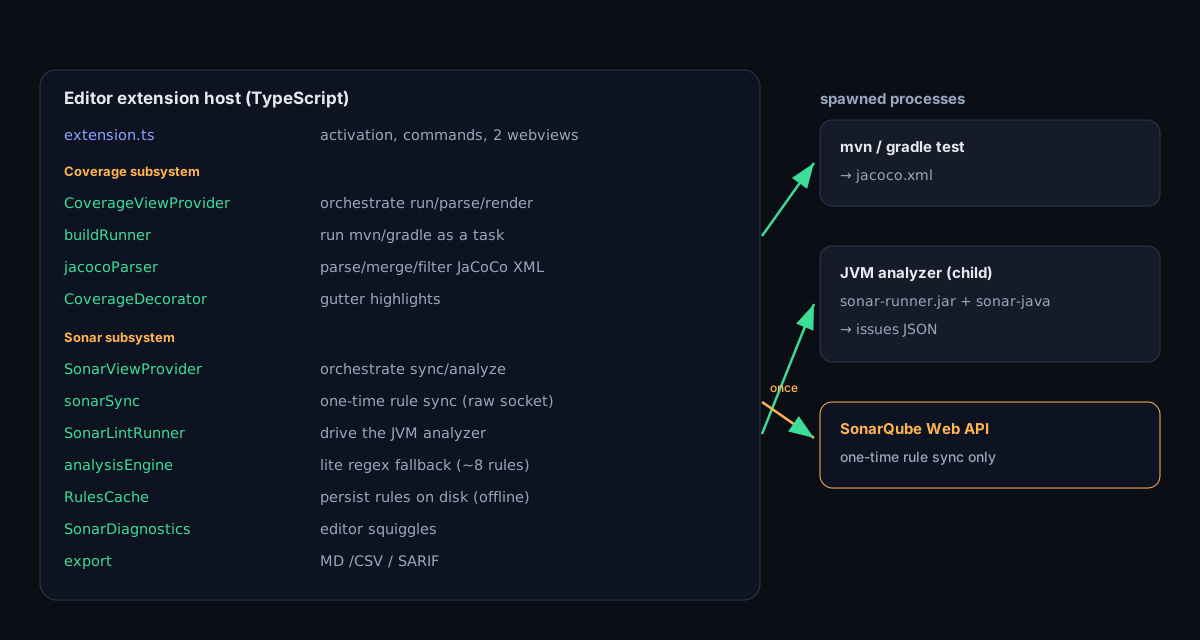
Source layout
src/
  extension.ts                 # activation, command + view registration
  types.ts                     # shared data models
  provider/
    CoverageViewProvider.ts    # coverage webview + orchestration
    SonarViewProvider.ts       # sonar webview + orchestration
  coverage/
    buildRunner.ts             # run mvn/gradle test as a VS Code Task
    jacocoParser.ts            # parse / merge / filter JaCoCo XML
    coverageDecorations.ts     # editor gutter decorations
  sonar/
    sonarSync.ts               # rule sync via Sonar Web API (raw socket)
    sonarLintRunner.ts         # spawn JVM sonar-java analyzer
    analysisEngine.ts          # lite regex fallback engine
    rulesCache.ts              # persist synced rules to disk
    diagnostics.ts             # publish issues as editor squiggles
    export.ts                  # MD/CSV/SARIF (issues) + MD/CSV (coverage)
resources/
  sonar-runner.jar             # JVM launcher (loads the plugin, emits JSON)
  sonar-plugins/sonar-java-plugin.jar
Build is tsc for type-checking, esbuild to bundle to dist/extension.js, packaged with @vscode/vsce. Every command is wrapped in a guard(name, fn) that logs start/done and, on error, surfaces the output channel plus a toast — so nothing fails silently.
Data models
CoverageMetrics { line, branch, instruction, method, class: {covered, missed} }
ClassCoverage   { name, packageName, resolvedPath?, origin?, metrics,
                  lines: Record<lineNr, {ci, mi, cb, mb}> }   // covered/missed instr+branch
CoverageReport  { reportPath, moduleName, metrics, packages, generatedAt }

SonarRule   { key, name, severity, type, language, htmlDescription?, params[], active }
SonarIssue  { ruleKey, ruleName, severity, type, message, filePath, line, startColumn?, endColumn? }
Overall coverage matches SonarQube’s definition:
coverage = (line.covered + branch.covered)
         / (line.covered + line.missed + branch.covered + branch.missed)
Coverage subsystem
jacocoParser reads JaCoCo XML with fast-xml-parser and processEntities:false (JaCoCo embeds many </> in names; entity expansion trips the parser guard on big reports). It recurses through <group> for aggregate reports and captures per-line ci/mi/cb/mb data for the gutters. mergeReports de-dupes classes by package::class (keeping the better-covered copy) so multi-module aggregates aren’t double-counted, then filterReport drops generated sources and excluded paths.
buildRunner runs the tests as a real vscode.Task (mvn -B test / ./gradlew test jacocoTestReport) and resolves with the process exit code. The CoverageViewProvider ties it together: run tests -> find reports -> parse -> merge -> resolve source paths -> apply exclusions -> push to the panel and the gutter decorator. A non-zero test exit shows a “tests failed, coverage may be inaccurate” banner rather than hiding the data.
Static analysis: a real engine, out of process
The headline decision is not reimplementing Sonar rules in JavaScript. Instead the extension spawns the real sonar-java analyzer in a child JVM and talks to it over a tiny file-based protocol:
// request file (TS -> jar)
{ "pluginJars": ["…/sonar-java-plugin.jar"], "baseDir": "…",
  "sources": [{ "path": "…/Foo.java", "test": false }],
  "includedRules": ["java:S106", …],
  "extraProperties": { "sonar.java.source": "17",
                       "sonar.java.binaries": "…/target/classes",
                       "sonar.java.libraries": "a.jar,b.jar" } }

// stdout (jar -> TS)
{ "issues": [{ "ruleKey":"java:S106","severity":"MINOR","type":"CODE_SMELL",
               "message":"…","line":30,"startColumn":4,"endColumn":20,
               "filePath":"…/Foo.java" }] }
SonarLintRunner.analyze() finds src/{main,test}/java/**/*.java (excluding build output), collects target/classes/target/test-classes as sonar.java.binaries, best-effort resolves sonar.java.libraries via mvn -o -q dependency:build-classpath, writes the request to a temp file, and spawns java -jar runner.jar req.json. The process boundary means an analyzer crash can’t take the editor down with it, and running the real plugin gives rule parity for free.
The three flows
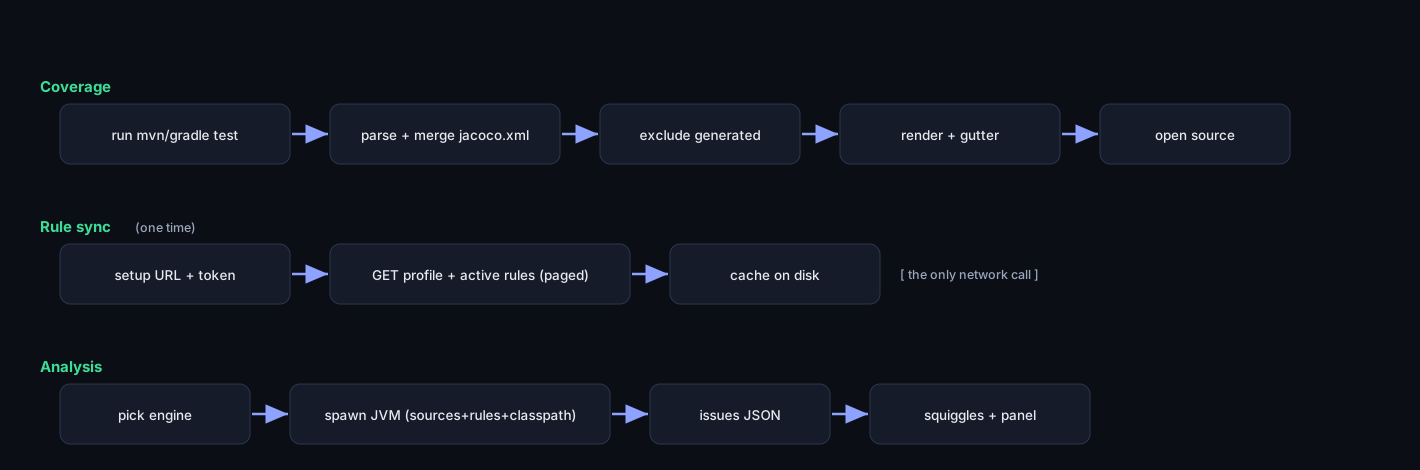
- Coverage — run tests, parse/merge
jacoco.xml, exclude generated, render gutters. - Rule sync (once) — pull the quality profile’s active rules over the Sonar Web API and cache them on disk. This is the only network call.
- Analysis — pick the engine, spawn the JVM with sources + active rules + classpath, turn the issues JSON into squiggles + a panel.
The lite fallback and engine selection
If there’s no JDK or the plugin jars aren’t usable, analysis degrades instead of hard-failing: analysisEngine is a pure-TS engine implementing ~8 rule checks (java:S106, S1135, S1134, S2068, S100, S101, S121, S1192, S108), running only the checks whose rule is active in the synced profile. resolveEngine() honors sonar.engine (auto|sonarlint|lite); auto uses sonar-java when available and falls back to lite — and a mid-run SonarLintUnavailableError also falls back with a warning.
The raw-socket sync detail
The one network call (rule sync) connects over a raw net/tls socket rather than Node’s http(s) stack. The editor proxy-patches Node’s HTTP, which can mangle exactly that request; writing a minimal HTTP/1.1 GET and de-chunking the response behaves like curl/the browser and sidesteps it. Sync resolves the quality profile, then pages GET /api/rules/search?activation=true&qprofile=…&ps=500&p=N and merges the active rules.
Storage and secrets
| Where | Key / file | Contents |
|---|---|---|
| Global storage (disk) | sonar-rules-cache.json |
The synced rule set (for offline use) |
| SecretStorage | codeInsights.sonar.token / .password |
Credentials — never in settings |
globalState |
sonar.suppressions |
Per-issue baseline mutes |
| OS temp dir | ci-sonar-req-*.json |
Analyzer request (deleted after the run) |
Suppression supports // NOSONAR (with NOSONAR(ruleKey,…) scoping) honored at analyze time,
plus a per-issue “mute” baseline. Webview HTML is a CSP-locked string with a per-render nonce.
Error handling and fallbacks
- Engine:
auto-> lite if jars/JDK missing; analyzer non-zero exit -> error with the stderr tail. - Classpath: a per-module
build-classpathfailure is swallowed -> syntactic rules only. - Sync: HTTP non-2xx -> a descriptive error (401/403 -> auth hint); socket error -> reachability hint.
- Config writes: a rejected settings write falls back to
globalState(post-reinstall safety). - Parsing: a bad
jacoco.xmlwarns and is skipped; one misbehaving lite check can’t abort the whole analysis.
Extension points
New coverage source -> extend the parser, reuse merge/filter/view. New export format -> add a function in export.ts + a quick-pick entry.
New lite rule -> add a checker to the registry. New language -> bundle the plugin jar and set the language key; the analyzer request is already generic.